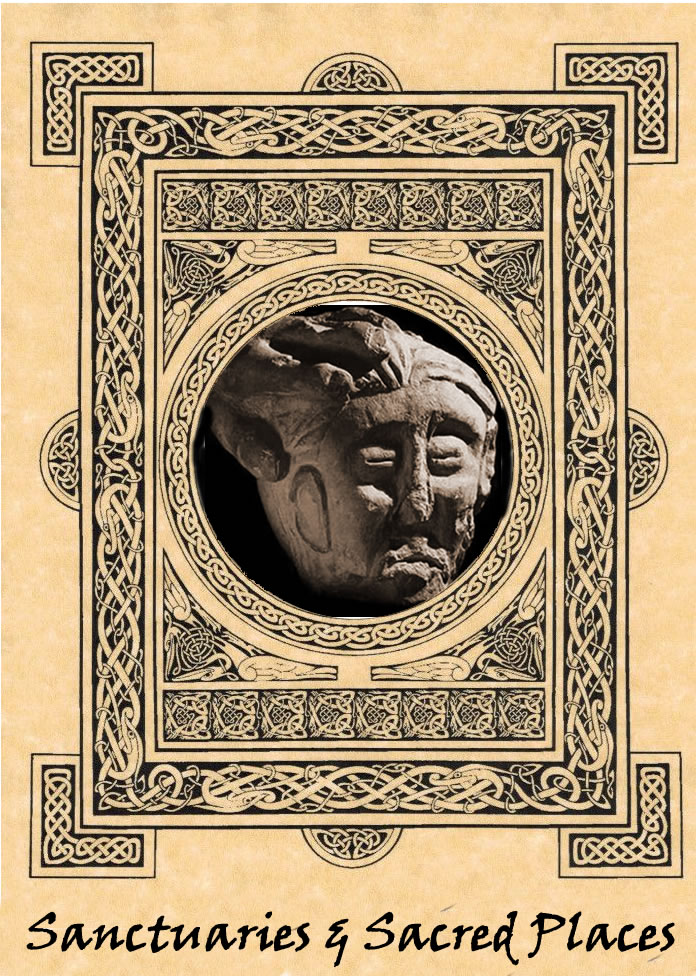
Showing posts with label Gaul. Show all posts

Saturday, 10 October 2020

Gaelic Folklore (38): Esus


Esus

1.

 “A pillar dedicated to Jupiter by the 'Parisian mariners' between AD 14 and 37 was discovered in 1711 under the choir of the cathedral of Notre Dame in Paris.  One shows the god Esus cutting branches from a tree. In the other there is a similar tree with a bull surmounted by three birds. It bears the title Tarvos Trigaranus, 'The Bull with Three Cranes'. That these two adjacent scenes belong together is confirmed by a relief from Treves  in which a man, similarly dressed in short working tunic, appears to be hacking the trunk of a tree in whose foliage are visible the head of a bull and the same three birds. These three components, the sacred tree, the divine bull and the triad of otherworld birds, are familiar features of insular Celtic tradition, and obviously we have to do here with some episode from a myth.  Unfortunately its precise content can only be conjectured. Musee de Cluny, Paris. “ 

2.

“M. d'Arbois regards this as illustrating the Tain. Esus, the woodsman, is Cuchulainn; his action depicts what the hero did -- cutting down trees to bar the way of Medb's host; "Esus" is derived from words meaning "anger," "rapid motion," such as Cuchulainn often displayed. The bull is the Brown Bull; the birds are the forms in which Morrigan and her sisters appeared, though these bird-forms were those of the crow, not the crane; the personal names Donnotaurus is found in Gaul and is equivalent of the Donn Tarb -- the "Brown Bull." 

“Cúchulainn, who had spent the night with a woman (some say his wife, others say differently), woke up later that morning and when he went out he found the tracks of the passing army.

'I was foolish,' he said to Laeg. 'I have let an army through and gave no warning to Ulster.' Determined and angry at himself, he and Laeg made haste and eventually overtook the advancing force. He settled down at the ford at Áth Gabhla and cut a massive tree-fork with one slice and set it deep in the waters of the ford so no chariot could pass that way. As he was finishing his task the four sons of Urard mac Anchinne came upon him. He cut off their heads and impaled them on the four points of the tree-fork. The chariot horses returned to the armies and the men there saw all the blood on the animals and thought there was a battle-force awaiting them at the river at Áth Gabhla. A company of men were sent to inspect the place, but all they saw was the track-marks of one chariot, the four heads impaled of the tree-fork, and Ogam writing on the side of the fork.

When the army met up with the company at the river Medb could not recognise the heads and asked if they were of her people.

'They are," said Ailill, 'and the very best of them too. How could they have been killed so easily? And what does that blasted Ogam say now!'

One of the druids spoke out the writing: One man, using one hand, had placed this fork. None may pass therefore unless another man - again, not Fergus - could do likewise.

'Very well," said Ailill, 'we will not attempt this challenge yet, if at all, but the messages says nothing about removing the obstacle. I leave that to you, Fergus.'

Fergus broke fourteen chariots in the attempt to remove the embedded fork. Only when he hitched up his own horse and chariot did he succeed in removing the fork from the riverbed.”

(An Táin Bó Cuailgne: The Cattle-Raid of Cooley)


3. 

What is known of Esus?

“Esus: The Roman poet Lucan described in a poem, the Pharsalia, dating from the 1st c. AD, the last great battle in the civil war between Pompey and Caesar. In it, he alludes to the journey of Caesar's troops through southern Gaul and their encounter with three Gaulish gods: Taranis, Teutates and Esus (Pharsalia I, 444-6). Lucan describes this triad as cruel, savage and demanding of human sacrifice: 'horrid Esus with his wild altars'. In later commentaries on Lucan's poem, probably dating from the 9th c. from Berne, Esus is mentioned as being propitiated by human sacrifice: men were stabbed, hung in trees and allowed to bleed to death. The two commentators equate Esus with Mars and Mercury respectively, but this may not pose as great a problem as it first appears, since the word 'Esus' is not so much a name as a title, meaning 'Lord' or 'Good Master'.

Whilst the implication of Lucan's description is that Esus was an important and powerful Gaulish divinity, this is belied by the archaeological evidence in which Esus may be traced to only two monuments. The more significant stone forms part of the pillar dedicated to Jupiter by Parisian sailors in the reign of Tiberius. The block from Paris was found with five others in 1711 on the site of Notre-Dame. The Esus stone itself is inscribed with his name, and beneath this is a depiction of a muscular god chopping at a branch of a willow tree. On a juxtaposed scene is another willow, a bull and three cranes or egrets, with the inscription 'TARVOSTRIGARANUS'. Essentially similar iconography recurs on a 1st c. AD stone at Trier, where an unnamed woodcutter attacks a willow in which repose three egrets and the head of a bull.

The symbolism of the two monuments, whilst not identical, is sufficiently similar and idiosyncratic for it to be possible to identify the presence of Esus on both. In addition to the image of the woodman, the willow, the marsh birds and bull appear on the Paris and Trier images. The iconography is obscure, but there is a natural association between bulls, birds, and willows: egrets feed on parasites in cattle hide; they, like the willow, are inhabitants of marsh or water margin, and egrets nest in willows. The woodcutting scene is problematical in terms of interpretation. It has been suggested that Esus prunes the tree for sacrificial purposes. It may be that there is a cyclical imagery in the destruction and rebirth of the Tree of Life in winter and spring: the birds may represent the soul in flight, perhaps the soul of the tree itself; the bull could himself be a sacrificial beast. Seasonal imagery may also be present in the symbiotic relationship enjoyed between bull and birds, which are of mutual benefit to one another. Finally, it should be recalled that trees are associated with Esus not simply in the iconography buy also in the Berne commentaries which describe the fate of Esus' sacrificial victims.” 

4.

Three clues offer themselves to the meaning of this deity:

1. His name;

2. The kind of sacrifice offered to him;

3. The ritual act on the altars from Paris and Trier. We will examine them in turn.

The word "Esus" is not unknown in Gaulish. We find it in the personal names Esunertus, Esumagos, Eusmopas, Esugenus. This name is found in Irish Eogan, in Welsh Ewein, Owain; even simply as Hesus. Perhaps also the name of the Esuvii tribe belongs to it. The explanation of this word can be broken up further, however. Dom Martin seeks a connection with the Breton word (h)euzuz, meaning "terrible." Others have thought it from Italic aisus, esus, "God," and the Etruscan Erus or also from the Latin herus, "Lord, Master." On the other hand, Vendryes explains the name from esu, "good" (cf. Gk. eus and also archaic Indic asura); but we hardly get the impression of a good god from the Berne scholia. Others would like to derive it from the Indo-European root *is, "to desire;" then arguing the sense: the one who fulfills men's desires. Perhaps better might be the derivation from the root *eis, which means "energy, passion." These are, however, only possibilities, which prove one more time that one can't come far with etymology.

That the scholia of Bern refer to horrible sacrifices also give us few clues to the significance of the god. Already the expression membra digesserit cannot be understood. Must one understand by it, "to tear up, to cup up?" Or do we rather have to deal here with a disposition of the limbs after the blood has flowed out? It is important that the sacrifice would be hung from a tree, because a tree likewise stands out as full of meaning in the pictured representations. The objection that we hear only seldom of hanging rituals among the Celts and that the chopping off of lime is completely unknown says little. What do we know about the bases of Celtic sacrifice? What the classical authors have told us of it is in any case terrible enough. If we consider the reports of these sacrificial practices reliable, Esus must seem to us to be a god of little friendliness.

Finally, the portraits from both altars. To what purpose does the god strike a tree? It seems to me completely erroneous to think of a simple forester god, and to connect Esus with clearing-work, or to see in him at all a manual laborer who provided the nautae of Paris with the necessary workforce for their ships. Likewise it is incorrect that the cutting down of trees would be regarded as a death, and then further to remind us of Maypole rituals. It seems even more to me that Esus in the picture is cutting the limbs of a tree; if one imagines that sacrifices for him were only just hung on the tree, once comes perhaps to the conclusion that god would have been shown here by the injury of a tree for the hanging-sacrifice.

We must admit, with W. Deonna, that the meaning of the myth is for us incomprehensible; perhaps the picture only refers to a single piece of the ritual. At any rate, I would like to assert that there can be not talk of a "rural" god of clearing-work. The relief of the blocks from Paris represents him in the same rank as Jupiter and Volcanus. The Berne scholiasts compare him with the great Roman god; it remains only questionable whether he is Mercury or Mars or perhaps neither of them. The Esus-complex has also been compared with Hercules, and it has been pointed out in that regard that figures of bas-reliefs with the name Smert… are themselves found; one could consequently think of a Gaulish Herakles or Donar, thus of a god of physical strength.

But that will not explain the hanging-sacrifice. When one accordingly takes this into consideration, the comparison with Mercury gains special meaning. If the German Mercury is simply Woden-Odhin, this go stands in undoubted connection with an act of sacrifice by means of hanging. It can likewise be said of both gods that they are also gods who protect travel: Odhin is called: [ed. note: obscured], thus "god of cargo;" he gives mariners good winds. The Paris altar was erected by nautae. On the other hand, one is reminded how cautious one must be with one's interpretation. Great gods are always ambivalent; their power extends into many areas of life. Odhin is not only a god of force, but of tricks and intrigues, of crafts and skillfulness. Exactly for these reasons could the mariners have worshipped him. The god to whom the hanging-sacrifice was offered was also, however, a cruel god. In that vein one could point to the name "Esus," if one accepts O'Rahilly's etymology; but also the interpretation of Vendryes deserves consideration, if one thinks that the name "the good god" is perhaps to be considered as only a euphemism.

All in all: the account of the hanging-sacrifice and the picture on the Paris altar sets out as the nearest course of assumption that Esus was a name for the head god of the Gauls and perhaps most likely to be compared to Mercury and the northern Germanic Odhin.

 (1)  Proinsias Mac Cana, Celtic Mythology.

 (2)  John A. MacCulloch, Celtic Mythology.

 (3)  Miranda J. Green, Dictionary of Celtic Myth and Legend.

 (4) Jan de Vries, Keltische Religion.


1  

Thursday, 8 October 2020

Gaelic Folklore (35): The Celtic Goddesses Healer


The Celtic Goddesses Healer

Introduction

The evidence for a healer-goddess in Celtic Europe during the early first millennium AD is based almost entirely upon iconographical and epigraphic evidence. Certain concepts need to be introduced here in order that the role of the Goddess as healer may be better understood.

First, there is a strong link between religion and medicine: this is something that is evidenced both in the classical and in the Celtic world. Sick people in antiquity relied upon the healing skills of the supernatural powers at least as much as upon empirical medicine. Indeed, at many therapeutic sanctuaries in Gaul and Britain, doctors were present as well as priests, for example at Fontes Sequanae and Bath; it is even possible that the two roles were sometimes combined in the one individual.

Second, the perception of the numinous in water is important. There is abundant evidence in non-Mediterranean Europe from at least the later Bronze Age—say around 1300 BC—that water was a central focus of ritual activity. During the later Iron Age this activity began to manifest itself in the development of healing sanctuaries on the sites of thermal springs, a phenomenon which burgeoned in the Romano-Celtic phase in the Rhineland, Gaul and Britain.

Third, the evidence for healing cults in Celtic Europe demonstrates a very close link between healing, regeneration and fertility, which may account for the fact that many Celtic divine healers were perceived as female, and for the strong association between curative cult establishments and the mothergoddesses. There is evidence that many devotees of healing-deities were women; the fact that most stone altars were dedicated by men probably does not reflect anything other than economic or social factors. Women may not normally have had the means to erect expensive stone monuments as readily as their male counterparts. However, the cult of Apollo Vindonnus at Essarois in Burgundy seems—from the exvotoes— to have been patronized by women. The lady wearing a torc whose wooden image was dedicated at the thermal shrine of Chamalières in the first century AD was probably a devotee, but it is just possible that she may have been the goddess herself. There is a small amount of evidence for the association of women with the healing professions: at Grand in the Vosges, a stone of Romano-Celtic date depicts the inside of a chemist’s shop with a female chemist at work with mortar and herbs. An inscription and image on a tombstone at Metz betray the presence of a female doctor in the first century AD.

Fourth, we must be wary of positing theories- about the status of women in Celtic society from the importance of the Goddess. Having sounded this note of caution, it is, however, interesting that classical literary references to Celtic women contain many allusions to the contrast between their status and that of their more lowly Mediterranean sisters.

Sequana Of Burgundy

Sequana was a water-spirit, the personification of the River Seine at its source, Fontes Sequanae. Here, in the valley of the Châtillon Plateau, a spring of fresh, pure water wells up from the ground and was the focus of religious devotion from the later first century BC. The spring is pure but it contains no genuine mineral properties. Sequana is special in that she is not paired with any Roman goddess; her name is known from about ten inscriptions, and there is a bronze cult-statue of Sequana herself. In 1963, during the excavation of buildings dating to the Roman period, more than 200 wooden votives were discovered in water-logged ground, apparently pre-dating Roman levels and originally set up perhaps around the sacred pool. The pre-Roman activity centered upon the pool itself; there is no evidence of permanent structures at this time. Shortly after the Roman occupation of the region the sanctuary was monumentalized and the spring canalized. It was now an extensive religious complex, containing two temples, porticoes, a dormitory and reservoirs, still centered on the sacred spring and pool. The votive images were now of stone. In common with the activities at classical healing shrines, sick pilgrims visited the sanctuary bearing offerings—possibly bought at the shrine shop—bathed, slept, and asked for a cure with gifts of models of themselves or their afflictions. Eyes, chest, genitals, limbs—these were just a few of the complaints represented by the votives. The eye problems so prevalent at many shrines could have been due to poor hygiene or malnutrition: a lack of animal fat can cause night-blindness. The votive model breasts in bronze and silver may denote milk deficiency, a serious problem for child-rearing in antiquity. Sequana was not a specialist: she healed all afflictions.

Sequana

Sirona And Her Peers

There is a group of continental healer-goddesses who have a common characteristic: namely, the possession of a male partner. It is the case with the healers, as with other divine couples like Mercury and Rosmerta, that the native goddess seems often to possess a wider variety of functions and concerns than her consort and, in addition, is the less influenced by Graeco-Roman traditions. These goddesses usually have completely native names, and symbolism which is less influenced by Graeco-Roman art forms than their male companions. In addition, they show evidence of independent identity: they are not mere female ciphers attached to the cults of male divinities.

Sirona

Sirona


Sirona is the divine partner of the Celtic healing Apollo, normally called Apollo Grannus (a native epithet associated with Grand in the Vosges). But she occurs alone, for example at Corseul in Brittany, where she is called Tsirona; her high rank is shown by inscriptions where she is linked with the spirit of the emperor. Sirona was venerated alone also at Baumburg in Noricum (Austria). Her cult was widely distributed and may well have pre-dated the Roman occupation of Gaul and elsewhere. Sirona was at her most popular among the Terveri: the main cult-centre was at Hochscheid, a spring sanctuary in the Moselle Basin, to which we shall return. But, elsewhere among the Treveri, Sirona was invoked at Nietaldorf, Bitburg and Sainte-Fontaine, and among the neighbouring Mediomatrici at Sablon, Metz. Sirona’s spring-cult is evidenced at Wiesbaden, Mainz and Luxeuil and even at Brigetio in Hungary, where, in the third century AD, a temple was set up to Apollo Grannus and Sarana. In the second century AD a temple was erected at Hochscheid, on the site of a spring whose waters supplied a cistern. The evidence of coins suggests that this building replaced an earlier shrine, perhaps of wood. Pilgrims offered presents of coins, figurines, etc. It seems to have been a wealthy shrine for so remote a region, perhaps a personal endowment by a prosperous trader or villa-owner who had occasion to be grateful to the guardians of the spring. 

The imagery here is interesting and Sirona’s is the more informative. There were large stone statues of Apollo and Sirona; he is entirely Classical, but Sirona is represented as a woman in a long robe and a diadem, a snake round her right forearm, and a bowl of three eggs held in her left hand. The serpent/egg symbolism is essentially regenerative as well as curative. The snake’s skin-sloughing habit gives it symbolism of rebirth and perhaps also the idea of sloughing off disease. Clay figurines brought to the shrine as gifts show Sirona seated, like a mother-goddess, with a small lapdog, which is perhaps indicative of healing. There is an Irish historical link between women and lapdogs which is suggested by Cormick as being possibly associated with the use of these animals as ‘hot-water bottles’ to comfort period pains. The imagery of the couple in bronze at Malain in Burgundy is essentially similar to that at Hochscheid: this group has a dedicatory inscription beneath the images. On other sites, the fertility aspect of Sirona’s cult is evidenced by the imagery; for example, at Sainte-Fontaine, where the goddess bears corn and fruit, and at Mainz and Baumburg where she is accompanied by ears of corn. This symbolism of the earth’s abundance bears out the association between healing springs and the mother-goddess cult. Sirona’s name is interesting: it is philologically related to ‘star’, so perhaps associated with night and darkness. There could be a link with the moon, the female menstrual cycle and the darkness of the womb.

Sirona and Apollo

Ancamna and Damona

These two continental goddesses are distinctive in their apparent polyandry, changing partners from site to site. Ancamna is known only from epigraphy. She was a Treveran deity, partner of Lenus Mars at Trier. But at Moehn, a rural sanctuary where Lenus was also venerated, Ancamna was coupled with Mars Smertrius, another native version of the Roman god. Is this the same deity with two names, or are they separate entities? Mars’s association with healing is common in the Celtic world, where his war role was transmuted into that of a guardian-protector against disease, as at Mavilly, where he appears (with a goddess) dressed as a warrior, but accompanied by a ram-horned snake, symbol of regeneration. Mavilly was particularly renowned for the cure of eye disease. Damona’s name means ‘divine cow’ or ‘great cow’, and this may reflect her role as a goddess of wealth and fertility. But first and foremost she was a healer, worshipped especially in Burgundy; she had a number of partners, but her main sanctuary was at Alesia, where she was coupled with Apollo Moritasgus. The two were venerated at a shrine with a pool in which sick pilgrims bathed in the hope of a cure. No image of Moritasgus survives but there is a fragment of Damona’s statue, showing a strong link between her iconography and that of Sirona: a carved stone head is crowned with corn-ears and a hand entwined with a serpent’s coils. At Bourbonne-Lancy, Damona’s consort was Borvo, another spring-god, and an inscription from the curative shrine relates to Damona’s association with the therapeutic sleep enjoyed by pilgrims seeking a healing dream or vision from the divine healers. The names of both Borvo and Moritasgus mean ‘bubbling’ or ‘seething’ water. 

At another Burgundian shrine, Arnay-le-Duc, Damona’s partner is yet another god, Abilus. Again a fragmentary image of the goddess represents her with a stone snake curled round a human arm. It is worth remembering that the Graeco-Roman healer-god, Asklepios, is often depicted with a coiled serpent. The polyandrous nature of Damona’s cult supports her status as an independent native divinity whose identity was not based on her association with any one god. Her rank is further enhanced by epigraphic evidence from the curative sanctuary of Bourbonne-les-Bains, where Damona was worshipped alone.

Ancamna and Mars Smertius

Other Gaulish Spring Goddesses

Many other spring-goddesses are recorded only on inscriptions, often again associated with male partners: Bormana and Bormanus were venerated in southern Gaul; Luxovius and Bricta at Luxeuil. Others were lone goddesses: Telo was the eponymous spring-spirit of Toulon in the Dordogne; Januaria at Beire-le-Châtel in Burgundy is mentioned on a statue of a figure playing pan-pipes. We have little clue as to Januaria’s precise function, though she was worshipped at a curative shrine. The musical instrument may indeed be a symbol of healing sleep, just as in vernacular myth healing deities such as Cliodna were associated with music—this time with singing birds. The name of the Treveran goddess Icovellauna may be linked with water-imagery: she was venerated at Trier and at the thermal springs of Sablon, Metz. Aveta was a spring goddess of the Treveri, to whom pilgrims at Trier offered small clay figurines of mother-goddesses with baskets of fruit, with dogs or with babies.

Sulis: Healer And Avenger

The site of Bath, Aquae Sulis, was sacred before the Roman period: this is implied by the presence of eighteen Celtic Iron Age coins from the lowest levels. Early in the Roman period—just fifteen years or so after the occupation—a great temple, baths and a huge religious precinct were constructed around the great spring, which pumps out hot water beside the River Avon at a rate of a quarter of a million gallons a day; a huge altar was set up in front of the temple, and a reservoir containing the main spring enclosed by a low stone wall. This was a great Neronian or Flavian building programme using Roman engineers.

There were major alterations c. AD 200, which argue for a new slant to the cult: the temple was enlarged but the reservoir, which had been visible all over the precinct, including the baths, was enclosed in a huge vaulted hall, restricting both physical and visual access to it, and making the water more remote and mysterious. Pilgrims could now only approach the spring through a dim passageway—does this imply Otherworld symbolism?

The goddess at Bath was Sulis, a native deity, but she was equated with Minerva, which seems a curious conflation. If Sulis really is a healer-goddess, as her presence at the hot spring implies, then she may be linked with Minerva because the latter was perceived as goddess of the craft of medicine. But in addition there is a philological link between the name Sulis and the sun—the sun and healing were closely linked in the Celtic world.  Indeed the solar association may have come about at least partly because Sulis’s springs were hot.

The cult of Sulis flourished until the mid-fourth century AD. The springs have genuine medicinal properties which are good for such ailments as arthritis and gout; this must have gained Sulis a reputation for being able to cure everything. There were many devotees who donated ivory and bronze model breasts, spindle-whorls and jewellery. But unlike—say—Sequana’s shrine, very few anatomical votives have been found. Pilgrims visited the shrine perhaps for a physical cure, or perhaps more often for spiritual refreshment. Immersion, purification, imbibing the water and thus the spirit of the goddess, the healing sleep, sacrifice, festivals and prayers all must have taken place here, as well as the offering of gifts. The spring appears to have been the focus of personal contact with the goddess, to whom prayers, vows, requests and thanks were made. Stone altars record gratitude for Sulis’s help. Money, rings, brooches and combs as well as other personal offerings were cast in, some by women, perhaps sometimes on impulse.

Ritual activity is represented at Bath: a priest of Sulis, Calpurnius Receptus, died here aged 75. A haruspex (literally ‘gut-gazer’) may have been present in a personal rather than an official capacity. Part of a head-dress was found, suggesting liturgical regalia. About 12,000 coins come from the reservoir.

This seems a large quantity but it works out as only an average of c. 24–48 coins a year. The presence of silver, pewter and bronze vessels could represent a ritual purpose (the drinking or pouring of the sacred water), but they could also have been offerings.

The question needs to be asked as to whether the assumption that Sulis is primarily a healer-goddess is valid. The only real evidence is her presence at the site of a major thermal spring. The third-century Roman writer Solinus refers to Bath having springs ‘furnished luxuriously for human use …over them Minerva presides’. There is no mention of healing. The inscriptions dedicating altars to the goddess do not specifically mention the curing of disease, whilst this does occur at Fontes Sequanae. Most importantly, there is a significant lack of anatomical votives, which are such clear indications of healing cults elsewhere. Certainly, I think, we have to reconsider Sulis’s role, even though the hot springs must have played a genuine part in the establishment of the cult.

Sulis / Minerva

The diversity of Sulis’s cult is nowhere shown more clearly than in the extraordinary group of 130 lead and pewter curses or defixiones from Bath found in the reservoir where they had been cast by vengeful devotees. This aspect of the goddess’s nature and powers is seemingly at variance with the role of benevolent healer. Sulis was clearly perceived as an avenger of wrongs. Water and curses have a well-established link; as late as the nineteenth century in Wales, a man was imprisoned for inscribing a curse on a lead sheet and throwing it into a well. In a sense the named or unnamed malefactor was being symbolically sacrificed to the goddess. The ‘fixing’ was an important element of the defixio, so that the curse would not rebound on the curser. The choice of lead or pewter is significant both practically and symbolically. The curses are very harsh, associated with fertility, sleep, blood and internal disorders.

So there is a strong link with disease in this negative aspect of Sulis’s cult: Docimedes has lost two gloves. He asks that the person who has stolen them should lose his mind and his eyes in the temple where she appoints. Docilianus, son of Brucerus to the most holy goddess Sulis. I curse him who has stolen my hooded cloak, whether man or woman, slave or free, that the goddess inflict death upon him, and not allow him sleep or children, now and in the future, until he has brought my hooded cloak to the temple of her divinity.

The cult of Sulis, whatever its precise nature, was popular and successful, attracting people over a wide area and over long periods of time—nearly four centuries. If we are right to interpret her cult as primarily that of a healer, then the reversal of benevolence and vengeance is interesting. What the goddess could give she could also take away, especially if the evil deed was perpetrated within her sacred space.

Healing And The Mother-Goddesses

The symbolism of the divine female healers has already demonstrated a close link between curing, fertility and regeneration. The mother-goddesses themselves, often in their distinctive triadic form, appear at thermal spring-sanctuaries, presumably as healers themselves. There is a natural link between the mother, childbirth and women’s health before, during and after pregnancy.

The Mothers were perceived as protectors and nourishers of children. Good examples of mother-goddesses at springshrines include those at Vertault and Bath. At Aix-les-Bains, pilgrims at the curative shrine worshipped the Matres Comedovae, the med element perhaps referring specifically to health. The Matres Griselicae were the eponymous healers at Greoulx, the Glanicae at Glanum, and the

Nemausicae at Nîmes, all in Provence. At Arrington in Cambridgeshire, a recent discovery consists of the burial of an infant who died of hydrocephalus: he was placed in a coffin on top of which was a group of clay figurines, including a mother-goddess of distinctively Rhenish type. Was she placed in his grave as a symbolic mother but also as a healer, so that he would be whole in his life in the Otherworld?

The association between mothers and healers is enhanced by certain aspects of their symbolism, notably the presence with them of such animals as dogs and snakes. Dogs were associated with self-healing, and there were sacred dogs at the great healing sanctuary of Asklepios at Epidaurus in Greece. In Britain, images of dogs were notable occurrences at the healing shrine of Nodens at Lydney. We have seen the association between dogs, Sirona and Aveta. Snakes were potent symbols of rebirth and fertility, again associated with healing.

-Conclusion

From our own experience in modern times we know that health figures prominently in, for example, governmental responsibility and spending. Health is a fundamental concern to humankind and must always have been so. In antiquity, many diseases that to us are commonplace and curable were neither understood nor capable of effective treatment. So the gods played a crucial role in the physical and spiritual well-being of the community.

In the Celtic world, we know of many great healing-cults which were more or less influenced by the imagery and belief-systems of the Classical world. But I think it fair to say that some of the most interesting cults were those centred upon the goddesses; Sulis, Sequana, Sirona and their sisters in healing all presided over important popular sanctuaries to which pilgrims were attracted from far afield, drawn by the successful reputations of the goddesses.

The links between healing and fertility are interesting, and these appear to be specific to the female healers. Perhaps more fascinating still is the reversal of beneficence and malignancy in Sulis’s cult, where curing and cursing were both under the goddess’s jurisdiction.

The healing deities may have played a large part in people’s lives not only because they attended to their physical well-being but also perhaps because they offered spiritual renewal. This is not usually evidenced archaeologically but it is more than likely that pilgrims prayed to these divinities for many and complex reasons other than those of pure health.

Perhaps the most fascinating aspect of the healing-goddess cult is the manner in which it has survived into modern Christianity all over Europe. There are numerous instances of shrines to the Virgin Mary as a healer to whom pilgrims have come in recent years as suppliants, bearing gifts identical to those found in such sanctuaries as Fontes Sequanae. I will give just one example, from Malta, where Melleiha Bay, a subterranean shrine to Mary, cut into the rock, is associated with a natural spring. The gifts which decorate the walls include wax or silver models of limbs, hearts or eyes, baby clothes, shoes, crutches, plaster-casts, X-rays, pictures of children, even crash-helmets: all offered to Mary in hope or thanksgiving. There is a legend that the statue of Mary was often moved to a more respectable place within the main church later built above the original shrine but that, during the night, she always moved back down the forty steps to her old position by the spring. The dedications have been taking place for more than two hundred years and probably much longer; the shrine itself is said to be eight hundred years old. The link between divine female presence, spring-water and healing, shown here, is indistinguishable from perceptions of pagan Celtic pilgrims in the early first millennium AD.

Miranda Green, The Concept Of The Goddess, Chapter Two.

Wednesday, 7 October 2020

Gaelic Folklore (34): Sanctuaries and Sacred Places


Sanctuaries and Sacred Places 

Drawing on iron age texts and a critical examination of archaeological data, it is possible to suggest some key features of the sacred spaces among the Celts.

Written Evidence

As the iron age Celts made limited use of writing, textual accounts of Celtic peoples derive almost entirely from Graeco-Roman sources. Those classical texts contemporary with the Iron Age are most relevant to a discussion of iron age sites, and the present account concentrates on these. As the product of an external, conquering society, classical commentaries are in many ways a problematic source of data on the Celts. But at the same time, such accounts are iron age artefacts, and when treated as such can yield much information.  Most classical accounts of Celtic sacred space date to the later Iron Age (i.e. La Tene D; C.120-0 Bc). Greek colonization in the western Mediterranean, under way by the sixth century Bc, and Celtic expansion into northern Italy from the fourth to second centuries Bc and Asia Minor from the third generated limited textual data on the Celts, but it was only from C.125-120 Bc, with Roman intervention in the Provincia, that significant quantities of data emerged on Celtic peoples and practices. The date of these texts ensures that the question of Graeco-Roman influence, both on Celtic practices and on their literary depiction, is ever-present in assessing the literary evidence. 

Underlying most iron age texts is thus a common theme: a sacred area comprising or including an enclosure. How such enclosures were realized is nowhere specified, but the concept of sacred enclosure is clear. Ironically, given their interest to the excavators of the weapon-rich sites discussed below, almost the only texts for which enclosure remains an uncertainty are Caesar's references to loci consecrati (sacred spots). Caesar uses the term for the druidic meeting-place among the Carnutes of Gaul and for heaps of battle spoil dedicated to 'Mercury'. In the latter case, Caesar simply says that booty was piled up in heaps; enclosure need not be implied. Elsewhere, Diodorus referred to booty being taken off the battlefield, without specifying its fate. Livy suggested spoils were heaped on the battlefield, apparently ruling out formal structure, but wrote with reference to the Celtic sack of Rome in 390 Bc. As Brunaux suggested, battlefield booty heaps may have been used in foreign territory, when spoils could not be moved to existing loci. Whatever the case, it is clear from Caesar's account that in later iron age Gaul booty heaps were conceptually bounded by their taboo status. The almost total absence of any detail on construction and use make it difficult to determine the nature of Celtic cult sites. But the formalized structuring of space, incorporating enclosing works, is suggested by most texts.

A 'Natural' Religion?

'Natural' loci such as woods, groves and trees are often advanced as Celtic cult loci par excellence. This concept of Celtic sacred space derives in part from classical texts, but references on this theme do not commence before the first century AD, when woodland sites are frequently associated with the druids. Iron age references to 'natural' loci are rare. In C.100 Bc Artemidorus commented on an open-air ritual at Cape St Vincent in western Spain, and Poseidonios on the use of lakes as sacred repositories in the Toulouse area of the Provincia. Strabo also stated that the Celtiberians worshipped a nameless god outside their houses.

Although only Artemidorus makes explicit reference to the absence of structures, all three texts may imply rituals without use of formal (roofed) structures, or otherwise involving the restructuring of space; for example by construction of an enclosure. There are no other iron age references to such 'natural' cult sites.

The first-century AD change in emphasis to woodland sites is ignored by archaeological commentators except Wait, although we can advance reasons for a change in practice at this point. Imperial proscription of the druids could have forced the use of secluded locales. Equally, as Chadwick noted, the textual association of druids and groves could be the result of a spurious etymology, voiced in Pliny's suggestion that 'druid' derives from the Greek word for oak.  It is not impossible that the association of groves with Celtic religion is a literary construct of the first century AD.

The concept of nature-based Celtic religion is also predicated on the apparent paucity of archaeological evidence for tectonic loci. As such sites would leave little archaeological trace, this proposition remains difficult to test, but it is important to note that the archaeological record is likely to be biased in favour of formal structures. Bearing this in mind, what evidence can be adduced for 'natural' loci?

Nemeton

Nemeton is a Celtic descriptor for sites of cult significance. Nemeton is attested mainly in post-conquest place-names and epigraphy, over a wide area. Place-names include Augustonemetum (Clermont-Ferrand) and Nemetodorum (Nanterre) in Gaul, Nemetobriga (near Ortense) in Spain, and Medionemeton (near the Antonine Wall) in Britain. Epigraphic attestations include Mars Rigonemetis from Britain (Nettleham) and Nemetona from Altripp (Spier). Nemeton is commonly glossed 'sacred, with little indication that it principally denoted such sites. It is suggested nemeton had several meanings, including grove or clearing and small shrine or chapel (d. the Irish nemed, glossed sacellum, suggestive of a small shrine). Formal structural associations are a possibility for some examples, as at Vaison-la-Romaine (Vaucluse, France), where an inscription records the dedication of a nemeton to Belissama. and the context suggests a structure or precinct. Nemeton thus remains enigmatic. The most acceptable gloss, MacCana's 'a sacred place', simply emphasizes how little we may infer from the term regarding the form of Celtic cult sites.


Trees and Groves

Groves continue to be advanced as Celtic cult sites, essentially by reference to nemeton attestations, and the first-century AD texts discussed above. Such sites would have little archaeological visibility, but some recent discoveries may suggest that representations of trees were employed in cult contexts. These are the finds of bronze leaves at the St-Maur sanctuary (Oise, France) and the remains of a golden tree from a pit at Manching (Bavaria). These finds are problematic; the Manching tree, which probably dates to the third century BC, and from which were suspended golden leaves and fruit, is apparently of Greek manufacture. The cult association of the find, which is not from one of the possible Manching cult foci, is also uncertain. Iron leaves, again designed for suspension, were found in a settlement context at Villeneuve-St-Germain (Aisne, France). The positioning and use of such finds within sanctuaries (where related to these) are as yet unknown.

Water

'Watery' loci such as a springs, lakes and bogs have traditionally been argued as important sacred spaces for Celts.

Springs

Springs are commonly seen as a focus for Celtic rituals. Textual evidence in this respect is very sparse. Hirtius' account of the diversion of a spring at Uxellodunum in 51 BC, and the subsequent surrender of the oppidum is a possible reference of iron age date, but a utilitarian function could well be implied for this spring. The one reference to springs in a clear iron age cult context is Lucan's overwrought account of a Lucus near Marseilles, written in the first century AD with reference to the Civil War.

Archaeological evidence for springs as pre-conquest cult foci is virtually non-existent. The argument for Celtic use of such loci is heavily dependent on the well-documented post-conquest use of springs for cult purposes. Finds of wooden statuary (a non-classical medium) at the Cote d'Or sites of Sources de la Seine and Elssarois and at Chamalieres (Puy-de-Dome), and elsewhere in France, have been argued to show a Celtic presence at springs, but can nowhere be dated before the first century AD. The recently excavated examples from Montlay-en-Auxois (Cote d'Or) were found in wooden catchment pools dated by dendrochronology to AD 86-119.

On the other hand, cult activity occurred from the early post-conquest period at many springs: Luxeuil and St-Marcel (Indre), Avord and Sagonne (Cher), Vichy (Allier), Chateauneuf-Ies-Bains (Puy-de-Dome), and Coren and Vic-sur-Cere (Cantal) have all produced early post-conquest coins or ceramics. There are two ways to consider this phenomenon: either by the retrospective inference that such sites are close enough in date to the Roman intervention to suggest they represent the survival of pre-conquest practices; or as a veritable post-conquest phenomenon. On present evidence, the balance is in favour of the latter.

Lakes

Poseidonios, who visited Mediterranean Gaul in C.IOO BC, refered to sacred lakes as repositories for treasures among the Tectosages of Toulouse. This passage is often cited as evidence for a widespread use of sacred lakes by Celtic peoples, but the text is clearly specific to the Tectosages. Archaeological evidence for lakes in cult contexts is, however, more widespread. The deposition of high-value metal in watery contexts, including lakes, is well attested archaeologically in Atlantic Europe. This practice increased during the Iron Age in Britain, though on the Continent it declined after the second century BC. Numerous lakes are interpreted as depositional cult foci, including Llyn Cerrig Bach (Anglesey) and Carlingwark (Scotland). A similar interpretation was originally advanced for the lake site at La Tene, (Neuchatel, Switzerland), where thousands of weapons and tools, and some jewellery and coins, were found.

Bogs

Bogs also served as foci for metalwork deposits. This practice was not restricted to Celtic peoples, and features for example in Germanic cult. The Gundestrup Cauldron, widely seen as the quintessential 'Celtic' cult artefact, was in fact found in a bog in Himmerland, Denmark.  Human remains are mainly known from Germanic contexts, but sometimes occur in Britain and Ireland. The Lindow bog body (Lindow Moss, Cheshire) is a recent example. Dating of the body is problematic, but radiocarbon dates from the most recent analysis cluster around the first century AD. Lindow man suffered a threefold death (by axe blows, garrotting and cutting of the throat). This triplication suggests a death with ritual links. Where datable, however, British bog bodies are mainly of bronze age or Roman date, and their ritual associations unclear. The extent to which such deposits represent an iron age ritual phenomenon is thus uncertain. 

There is some evidence that islands were favoured as cult sites by Atlantic Celtic peoples. Several texts may be noted in this context. Posidonius described a Gallic site on an island off the mouth of the Loire, served by female religious specialists. Tacitus, describing Suetonius' attack on Mona (Anglesey), associated the island with the druids and with women whom he compared to the Furies. After the conquest, Mela referred to virgin priestesses on the island of Sena (Brittany). Female religious specialists are linked to islands in all three passages. The implication is possibly of sexual boundedness. Islands are also physically bounded, relating them conceptually to other forms of enclosure noted here. In Britain, archaeological evidence for an island sanctuary occurs in the form of a wooden circular temple on Hayling Island.

A link theme in the above discussion is that of water as a boundary. Brunaux has suggested that lakes were natural sanctuaries, without enclosure or protection. This may not always have been the case, but water, or islands in water, clearly offer a ready-made form of enclosure. Both textual and archaeological evidence for iron age 'natural' foci is thus very restricted, the latter being largely limited to certain water categories. It is very likely that Celtic peoples did employ natural forces as cult foci, without restructuring their space. In the Graeco-Roman world, for example, such loci co-existed with formal, public, cult centres and the same is clearly probable for Celtic peoples. Indeed, it is possible to argue that our concept of Celtic religious life is distorted by the poor recognition of 'natural' cult loci by both classical commentators and archaeologists. In this context, the lack of textual data may reflect the fact that non-structural loci would not have been easily recognizable to external observers.

But at the same time, natural forces, including trees and springs, were familiar cult loci in the Graeco-Roman world.  It remains significant that almost all iron age textual references suggest, with varying degrees of certainty, that the designation of Celtic cult sites involved the restructuring of space. Equally, while the difficulties of archaeological recognition of 'natural' sites must be borne in mind when assessing their importance to the Celts, it is also reasonable to expect some positive archaeological evidence in their favour. In many of the cases examined above, this is clearly lacking.


Wells and Shafts

Wells and shafts have long been argued as Celtic cult sites. The British record has been comprehensively documented but evidence for iron age usage is extremely poor. Stronger evidence for ritual wells and shafts comes from the continent. Shafts have been recovered, for example, inside or under the banks of southern German Viereckschanzen. Bavarian examples occur at Holzhausen, Tomerdingen, Schonfeld and Kreutzpullach. Fellbach-Schmiden (Baden-Wiirttemberg) may also be noted in this context. At Holzhausen, three shafts up to 36.5 m deep were sunk in the Iron Age. The presence of organic material, burning within shafts, and the deliberate placement of a wooden stake and a flesh-hook in two shafts led the excavator to suggest these had been used for the disposal of sacrificial remains. At Fellbach-Schmiden fragments of three deer figurines were recovered from an oaklined shaft (by dendrochronology to 123 BC).

Beyond southern Germany, shafts with iron age fills are rare. Gallic examples are mainly restricted to the Provincia. The fills of some Toulouse shafts date to the first century BC (e.g. the ceramic-filled shaft from Vieille-Toulouse), but none securely predates the Roman intervention. Pre-conquest fills occur elsewhere in the Provincia, as at Nimes, but these shafts seem to have had utilitarian roles. Most Gallic examples postdate the Augustan era, as at Argentomagus  where shafts date to the first century AD and the first- to second-century AD examples at Chartres (Eure-etLoir) Given this dating, it is important to recall that the use of shafts for cult purposes was common in the Graeco-Roman world and it seems very possible that wells and shafts are essentially post-conquest cult loci.

Celto-Ligurian Sanctuaries

These well-documented stone-built structures of Provence include Entremont, Roquepertuse  and Glanum.

They comprise monumental propylaea, decorated with sculptured reliefs, frequently of the human head, and often associated with free-standing sculptures of cross-legged anthropomorphic figures. The dating of some examples is uncertain, but Entremont and Roquepertuse were probably destroyed during the Roman intervention in c. 125 Be. These sites provide much information on sanctuary structure, but they represent an exceptional, localized development, owing much to the long Greek contacts in the Bouches-du-Rhone area, and, with the exception of a dieu-accroupi from Argentomagus , do not appear to be replicated elsewhere in Celtic Europe.

Enclosures and their related structures

Until recently, it was thought that prior to the second century Be, iron age Celtic peoples rarely constructed special cult sites, and possible early sites like the early third-century Be rectilinear enclosure at Libenice (Prague) were considered exceptions to this rule. Excavation in the last decade, particularly in northern France, has changed this position somewhat (the sanctuary at Gournay-sur-Aronde (Oise), for example, has fourth-century Be origins), but it remains true that the majority of excavated cult sites employing enclosures do not predate 250 Be.

Viereckschanzen

This term was originally applied to a series of Bavarian rectilinear enclosures delimited by an earth bank and ditch, enclosing an area of approximately I ha.  Viereckschanzen were classified on morphological and typological criteria by Schwarz, who was influential in arguing for the cult function of such sites. In contrast to the 'Belgic' sanctuaries discussed below, the assemblages from excavated Viereckschanzen are generally very poor, and the cult function of most examples is uncertain. Sites across Celtic Europe, from Gosbecks in Britain to Msecke Zehrovice in Bohemia have been related to the Bavarian Viereckschanzen on morphological grounds. There has been a marked tendency to assume commonality of function across the series, and taking Holzhausen as an indicator, this role has often been argued to be a cult one. The recent doubts cast over Holzhausen are thus significant, not least because, despite numerous excavations, Holzhausen remains the sole site with a strong claim to a cult function. The excavators of Viereckschanzen-comparables in France, for example, have suggested utilitarian roles for enclosures at  and St-Arnoult. In addition, the perceived morphological and topographical similarities between the Bavarian sites and a set of proposed Viereckschanzen-comparables in the Limousin, France, have recently been shown to be statistically non-significant. It is likely that some sites now placed in the Viereckschanzen class served a cult function, but it seems clear that the category subsumes a variety of monument groups. Without independent excavation criteria, as yet lacking, unexcavated sites, and the majority of excavated examples, cannot be seen as cult loci.

Last decade, a series of excavations in the territory of the Bellovaci and Ambiani (Picardy, France) has substantially increased our knowledge of sanctuaries and attitudes to sacred space in Belgic Gaul. Sanctuary sites with features similar to those of Picardy occur beyond Belgic territory, but given the extent of excavation in Belgic Gaul, it is proposed to concentrate on that area here. Belgic sanctuaries include Gournay-sur-Aronde), Estrees-St-Denis, St-Maur  and Vendeuil-Caply  in Dept Oise; Ribemont-sur-Ancre, Morviller-St-Saturnin  and Chilly  in Dept Somme; and Mouzon  in Dept Ardennes. One of the best-understood sequences is that for the sanctuary at the centre of the oppidum of Gournay-sur-Aronde (Oise). The sanctuary site forms a rectilinear enclosure which in its first (fourth century Bc) phase measured 45 x 38 m and was defined by a ditch and low bank. In the late fourth to mid-third century Bc a palisade was added on the external edge of the ditch and in the late third to early second century Be a second ditch was added beyond the first. From its construction in the fourth century Be until C.30 Bc, the primary ditch was used to deposit over 2,000 broken weapons and 3,000 animal bones. At the center of the enclosure a group of pits was dug in the mid-third century Be. Nine roughly circular pits 1.2 m deep, surrounded a tenth, oval, pit in which cattle remains were allowed to decompose.

Around the end of the third century Be these pits served as foundations for a wooden building, replaced by two subsequent first-century Be structures. The latter, constructed c.30 Be, was of [anum form. Ditches serving as repositories for weapons, tools, and animal and human bone, associated with a central arrangement of pits which later saw structural formalization, occur at other Oise sites. These include St-Maur  and Vendeuil-Caply. At St-Maur, ritual activity commenced later than at Gournay, in c.250 Be. Many variations on the Gournay pattern are known, even within Belgic Gaul. At some sites assemblages are characterized less by weapons than by jewellery; examples here are Estn!es-St-Denis, Vendeuil-Caply and Morviller-St-Saturnin. Equally, certain sites, such as Estrees-St-Denis and Montmartin, are less clearly demarcated from their associated settlements than are others in the Belgic group.

A number of sites produce a high proportion of human bone. Among these is Ribemont-sur-Ancre (Somme), 50 km from Gournay. An iron age cult area was discovered here, near the principal temple of a vast Gallo-Roman cult complex. Over 200 long bones (mainly human, but also of horses) had been used to form a box-like construction, r.65 m sq, surrounding a post-hole filled with human ashes. Originally standing 1 m high, this ossuary was surrounded by iron weapons. A second ossuary has recently been excavated. Both examples stood in corners of a ditch-and-bank quadrangular enclosure, itself set in a vast enclosure over 200 m in length. Weapons and bones had been placed along the edges of the former. Two distinct dating episodes are noted at Ribemont: the construction of the ossuaries C200 Be, and a phase of deposition within the ditch, centred on the period of the Gallic War. The specific function of the site is unclear. The bone constructions could represent the massacre of prisoners, the remains of enemies killed in battle, or a collective sepulchre for the 'friendly' dead.

A second site yielding a high proportion of human remains is Mceuvres, Cambrais. Although Belgic sanctuaries thus exhibit considerable variety, two broad shared characteristics emerge: a rich assemblage of deposited material - weapons, often 'sacrificed' by deliberate damage, animal and human bones, and jewellery - and a palisaded/ditched enclosure. Many of the more fully excavated sites have also produced internal structures, but these generally postdate the enclosing works. This point is reconsidered below. Finally, whilst we know almost nothing of deity worship within these loci (or even whether this occurred), it is clear that deposition was a key ritual activity at such sites. These depositional acts were the culmination of a series of ritual processes, including the dismemberment and exposure of human and animal bone and the ritual sacrifice of weapons, well documented at Gournay-sur-Aronde (Brunaux and Rapin 1988) and Ribemont-sur- Ancre.

Throughout the Celtic world, there are very numerous occurrences of preconquest horizons at Roman period lana. The structural associations of these levels are unfortunately often uncertain, obliterated by the subsequent buildings, but frequently comprise pits or pit groupings, similar to those of the Belgic area. A recently excavated example occurs at Vertault (Cote d'Or). Enclosures with affinities to those of Picardy include Mirebeau-sur-Beze (Cote d'Or), Tronoen (Finistere) and Lousonna-Vidy (Switzerland). Weapons assemblages recently reinterpreted as deriving from cult loci include Nanteuil-sur-Aisne and Roizy (Ardennes) in the territory of the Gallic Remi. In Britain, numerous enclosed loci are proposed as iron age sanctuaries. Among these are a square palisaded enclosure surrounding a circular structure at Hayling Island, and a square, multi-ditched later iron age enclosure, overlain by a circular temple of the first century AD, at Gosbecks. Other examples are Uley, Lancing Ring  and Harlow.

The Importance of Enclosure

Enclosure was the primary and indispensable feature of Celtic cult sites. Some general points may be offered on enclosures in Celtic religious contexts. Enclosure is an act of boundary. Prior to the Late Iron Age, this boundedness was often underlined by the physical isolation of cult loci from settlement sites. The early La Tene quadrangular enclosure at the summit of the oppidum of Zavist (Bohemia) is one of earliest proposed cult sites to exhibit close settlement links. By the later Iron Age, many cult loci occur within settlement contexts. Others, like Ribemont, comprise rural loci which under the Roman hegemony develop into major cult complexes.

As the Belgic examples show, the early phases at most cult enclosures, delimited by a ditch and sometimes a palisade, had no accompanying internal structures. Crucially, in many cases, enclosure ditches were themselves a focus of ritual activity, serving as depositional zones. In the Celtic world, an enclosure ditch was often not simply a delimiter of sacred space; it was itself a primary focus of cult activity.


Weaponry, in particular, tends to be associated with ditches rather than with formal structures. The weapons assemblages of both Gournay and St-Maur were associated with the enclosure ditches; those of Ribemont with the ossuaries and the ditch edge, and during the first century BC weapons were also placed in the ditch. Formal structures occur at late stages in the history of these sites. Others may have had no structural phase at all, for example Mceuvres and possibly also the poorly documented closed deposits of weapons and horse gear such as the Masse at Tiefenau and Naillers.

Ditches, as depositional loci, were thus often intimately associated with cult activity. The relative chronology of enclosed cult loci merits stressing in this context. The perimeter - ditch and or palisade - tends to predate internal features. Later structures, often formalizing pit groups (as at Gournay and Vendeuil-Caply) tend to be square or rectangular in plan, culminating in square-plan that relates the form of internal structures to the plan of the enclosure itself, again emphasizing the pre-eminence of the enclosing works. Whether the development of formal structures is due to Mediterranean influence, as some commentators maintain is open to debate. But it is clear that an essential feature of many Celtic cult loci is the act of enclosure, less as sacred delimiter than as itself sacred space.

Space and Symbolism

Our understanding of the beliefs which structured the organization of sacred space among Celtic peoples is very uncertain. But the characteristics of cult sites allow us to see some underlying principles at work, if not the reasons for them. For example, many Celtic cult sites have east-facing entrances. This feature is by no means confined to sacred sites, but the frequent occurrence of easterly orientation suggests it was a symbolic referent informing spatial delimitation in many contexts. Posidonius, who says the Keltoi revere the gods by turning to the right, also recognized the symbolic importance of orientation, and may be describing a rite of circumambulation. In the first century AD Pliny noted Gallic circumambulation, apparently in the opposite direction. Similar rites have tentatively been evoked to explain the presence of an annular space, delimited by two palisades, at the St-Maur sanctuary. Other astronomical considerations may have influenced the structuring of space within enclosures. The internal structures at Libenice (Prague) were arranged with reference to the position of the sun and the solstices, and at Gournay (Oise) four posts at the centre of the enclosure marked the cardinal points.  Caesar's comment  on the druidic meeting-place at the center of Gaul may suggest the symbolic importance of centrality to Celtic peoples. This may also be reflected in the widespread occurrence of the element medio- (center, middle) in Celtic place-names . The British Medionemeton  is particularly relevant in this context. It is less clear whether this concept informed the structuring of sacred spaces on a microcosmic level, although Brunaux comments that most temples are placed at the centre of enclosures. Brunaux has also argued for a geography in which every natural phenomenon was deemed sacred by the Celts. At present, however, ideas on Celtic sacred geography remain speculative, articulated mainly by appeals to the medieval literature.

(The Celtic World, 1995, Jane Webster)

Sunday, 4 October 2020

Gaelic Folklore (31): The Humanised Gods Of Celtic Religion


The Humanised Gods Of Celtic Religion

One of the most striking facts connected with the Celtic religion is the large number of names of deities which it includes. These names are known to us almost entirely from inscriptions, for the most part votive tablets, in ac-knowledgment of some benefit, usually that of health, conferred by the god on man. In Britain these votive tablets are chiefly found in the neighborhood of the Roman walls and camps, but we cannot be always certain that the deities mentioned are indigenous.

In Gaul, however, we are on surer ground in associating certain deities with certain districts, inasmuch as the evidence of place names is often a guide. These inscriptions are very unevenly distributed over Gaulish territory, the Western and the North-Western districts being very sparsely represented.

In the present brief sketch it is impossible to enter into a full discussion of the relations of the names found on inscriptions to particular localities, and the light thus thrown on Celtic religion; but it may be here stated that investigation tends to confirm the local character of most of the deities which the inscriptions name.

Out of these deities, some, it is true, in the process of evolution, gained a wider field of worshippers, while others, like Lugus, may even have been at one time more widely worshipped than they came to be in later times. Occasionally a name like Lugus (Irish Lug), Segomo (Irish, in the genitive, Segamonas), Camulos, whence Camulodiinum (Colchester), Belenos (Welsh Belyn), Maponos (Welsh Mahon), Litavis (Welsh Llydaw), by its existence in Britain as well as in Gaul, suggests that it was either one of the ancient deities of the Aryan Celts, or one whose worship came to extend over a larger area than its fellows.

Apart from a few exceptional considerations of this kind, however, the local character of the deities is most marked.

A very considerable number are the deities of springs and rivers. In Noricum, for example, we have Adsalluta, a goddess associated with Savus (the river Save). In Britain 'the goddess' Deva (the Dee), and Belisama (either the Ribble or the Mersey), a name meaning 'the most warlike goddess,' are of this type. We have again Axona the goddess of the river Aisne, Sequana, the goddess of the Seine, Ritona of the river Rieu, numerous nymphs and many other deities of fountains. Doubtless many other names of local deities are of this kind.


Aerial phenomena appear to have left very few clear traces on the names of Celtic deities. Vintios, a god identified with Mars, was probably a god of the wind, Taranus, a god of thunder, Leucetios, a god of lightning, Sulis (of Bath) a sun-goddess, but beyond these there are few, if any, reflections of the phenomena of the heavens.

Of the gods named on inscriptions nearly all are identified with Mercury, Mars, or Apollo. The gods who came to be regarded as culture-deities appear from their names to be of various origins: some are humanized totems, others are in origin deities of vegetation or local natural phenomena. As already indicated, it is clear that the growth of commercial and civilized life in certain districts had brought into prominence deities identified with Mercury and Minerva as the patrons of civilization. Military men, especially in Britain, appear to have favored deities like Belatucadros (the brilliant in war), identified with Mars. About fourteen inscriptions mentioning him have 38 been found in the North of England and the South of Scotland.

The goddess Brigantia (the patron-deity of the Brigantes), too, is mentioned on four inscriptions: Cocidius, identified with Mars, is mentioned on thirteen: while another popular god appears to have been Silvanus. Among the most noticeable names of the Celtic gods identified with Mercury are Adsmerius or Atesmerius, Dumiatis (the god of the Buy de Dome), lovantucarus (the lover of youth), Teutates (the god of the people), Caletos (the hard), and Moccus (the boar).

Several deities are identified with Mars, and of these some of the most noticeable names are Albiorix (world-king), Caturix (battle-king), Dunatis (the god of the fort), Belatucadrus (the brilliant in war), Leucetius (the god of lightning), Mullo (the mule), Ollovidius (the all-knowing) Vintius (the wind-god), and Vitucadrus (the brilliant in energy). The large number of names identified with Mars reflects the prominent place at one time given to war in the ideas that affected the growth of the region of the Celtic tribes.

Of the gods identified with Hercules, the most interesting name is Ogmios (the god of the furrow) given by Lucian, but not found on any inscription. The following gods too, among others, are identified with Jupiter: Aramo (the gentle), Ambisagrus (the persistent), Bussumarus (the large-lipped), Taranus (the thunderer), Uxellimus (the highest). It would seem from this that in historic times at any rate Jupiter did not play a large part in Celtic religious ideas.

There remains another striking feature of Celtic religion which has not yet been mentioned, namely the identification of several deities with Apollo. These deities are essentially the presiding deities of certain healing-springs and health-resorts, and the growth of their worship into popularity is a further striking index to the development of religion side by side with certain aspects of civilization. One of the names of a Celtic Apollo is Borvo (whence Bourbon), the deity of certain hot springs. This name is Indo-European, and was given to the local fountain-god by the Celtic-speaking invaders of Gaul: it simply means 'the Boiler.' Other forms of the name are also found, as Bormo and Bormanus.

At Aqua Granni (Aix-la-Chapelle) and elsewhere the name identified with Apollo is Grannos. We find also Mogons, and Mogounus, the patron deity of Moguntiacum (Mainz), and, once or twice, Maponos (the great youth).

The essential feature of the Apollo worship was its association in Gallo-Roman civilization with the idea of healing, an idea which, through the revival of the worship of Aesculapius, affected religious views very strongly in other quarters of the empire. It was in this conception of the gods as the guides of civilization and the restorers of health, that Celtic religion, in some districts at any rate, shows itself emerging into a measure of light after a long and toilsome progress from the darkness of prehistoric ideas. What Caesar says of the practice of the Gauls of beginning the year with the night rather than with the day, and their ancient belief that they were sprung from Dis, the god of the lower world, is thus typified in their religious history.

In dealing with the deities of the Celtic world we must not, however, forget the goddesses, though their history presents several problems of great difficulty. Of these goddesses some are known to us by groups — Proximae (the kins-women), Dervonnae (the oak-spirits), Niskai (the water-sprites), Mairae, Matronae, Matres or Matrae (the mothers), Quadriviae (the goddesses of cross roads). The Matres, Matrae, and Matrontae are often qualified by some local name. Deities of this type appear to have been popular in Britain, in the neighborhood of Cologne and in Provence.

It is an interesting parallel to the existence of these grouped goddesses, when we find that in some parts of Wales 'Y Mamau' (the mothers) is the name for the fairies. These grouped goddesses take us back to one of the most interesting stages in the early Celtic religion, when the earth-spirits or the corn-spirits had not yet been completely individualized. Of the individualized goddesses many are strictly local, being the names of springs or rivers. Others, again, appear to have emerged into greater individual prominence, and of these we find several associated on inscriptions, sometimes with a god of Celtic name, but sometimes with his Latin counterpart. It is by no means certain that the names so linked together were thus associated in early times, and the fashion may have been a later one, which, like other fashions, spread after it had once begun. The relationship in some cases may have been regarded as that of mother and son, in others that of brother and sister, in others that of husband and wife; the data are not adequate for the final decision of the question.

Of these associated pairs the following may be noted, Mercurius and Rosmerta, Mercurius and Dirona, Grannus (Apollo) and Sirona, Sucellus and Nantosvelta, Borvo and Damona, Cicolluis (Mars) and Litavis, Bormanus and Bormana, Savus and Adsalluta, Mars and Nemetona.


One of these names, Sirona, probably meant the long-lived one, and was applied to the earth-mother. In Welsh one or two names have survived which, by their structure, appear to have been ancient names of goddesses; these are Rhiannon (Rigantona (the great queen), and Modron (Matrona, the great mother). The other British deities will be more fully treated by another writer in this series in a work on the ancient mythology of the British Isles. It is enough to say that research tends more and more to confirm the view that the key to the history of the Celtic deities is the realization of the local character of the vast majority of them.

Celtic Religion In Pre-Christian Times, By Edward Anwyl, M.A., Chapter V [1906]


Friday, 2 October 2020

Gaelic Folklore (29): Gallic Bloodrites


Gallic Blood Rites: Pleasing the Gods, Terrifying the enemy.

Excavations of sanctuaries in northern France support ancient literary accounts of Violent Gallic rituals:

“When their enemies fall they cut off their heads and fasten them about the necks of their horses; and turning over to their attendants the arms of their opponents, all covered with blood, they carry them off as booty, singing a paean over them and striking up a song of victory, and these first-fruits of battle they fasten by nails upon their  p175 houses, just as men do, in certain kinds of hunting, with the heads of wild beasts they have mastered. 5 The heads of their most distinguished enemies they embalm in cedar-oil and carefully preserve in a chest, and these they exhibit to strangers, gravely maintaining that in exchange for this head some one of their ancestors, or their father, or the man himself, refused the offer of a great sum of money. And some men among them, we are told, boast that they have not accepted an equal weight of gold for the head they show, displaying a barbarous sort of greatness of soul; for not to sell that which constitutes a witness and proof of one's valour is a noble thing, but to continue to fight against one of our own race, after he is dead, is to descend to the level of beasts.”

Diodorus Siculus, V.29

Modern historians, relying on reports by Caesar and others, have characterized the religion of the Celts in Gaul as spontaneous rites, in contrast to the well-planned cultic practices of the Greek and Romans.

Archaeologists have now revealed that the Gauls did, in fact, build permanent ritual sites at places like Gournay-sur-Aronde and Ribemont-sur Ancre in northen France. Dated to the end of the fourth or beginning of the third century B.C. these cult centers were the work of warlike tribes called the Belgae, thought to have arrived in northern Gaul from central Europe at the end of the great Celtic invasions of the fourth century B.C.

The rituals performed at Gournay-sur-Aronde and Ribemont-sur-Ancre, however, went well beyond animal sacrifice, a commonplace rite among the Greeks and Romans, and included the triumphant display of the remains of enemies killed in battle or sacrificed to the gods of the underworld, from whom the Gauls believed they were descended.  Evidence from excavations at these sites suggests similarities between Gallic religion and Greek chtonic (underworld) cults. A sunken altar recovered at Gournay-sur Aronde is similar to a Greek escharon, also consecrated to underworld deities. Although Greeks and Romans used stone while the Gauls used wood and mud brick, Gallic sanctuaries, like their Greco-Roman counterparts, were rectangular in plan, between 90 and 150 feet to a side.  Imposing wooden palisades enclosed the sacred inner precinct of these sanctuaries, accessible only by a monumental eastward-facing gateway.

Access to the inner precincts would have been restricted to priests, initiates and aristocratic dignitaries: the majority of congregants would have stood in the flat, open space outside the enclosed area. A structure within the enclosure housed and further protected the sunken altar. Animal sacrifice was the most common ritual offering of the Gauls. Relying on ancient texts and Gallo-Roman sculptures, historians of religion have long believed the Gauls caught wild animals for this sacrifice. Excavations of the sanctuaries, however, have revealed that from the end of the fourth to the beginning of the second century B.C. the Gauls, like the Greeks, also sacrificed common domestic animals principally cattle, pigs and sheep. Priests would offer the divinity a skinned animal carcass, which remained on the altar until it had decomposed. The skulls were usually nailed to the gateway, probably to fend off evil spirits.

Corroborating the accounts of the first century B.C. Roman historian Diodorus Siculus and other ancients, excavation clearly shows that human sacrifice was practiced as well. In the interior corners of the sacred inner precinct at Ribemont-sur-Ancre, human bones belonging to nearly 1000 enemy warriors were burned as sacrificial offerings in open-topped ossuaries, square-shaped structures five feet to a side, adorned on the outside with crisscrossed bones. The priests first crushed the bones, probably to expose the marrow, where the Gauls, like the Greeks, located the soul on which underworld deities feasted. After breaking the bones, the priests dumped them into the hollow central chamber of the ossuaries where they were buried. That the Gauls sacrificially burned their enemies  would surely have daunted anyone planning to wage war against them. Upon approaching a ritual site, a potential attacker might have seen smoke from burning bones rising from the sacred precinct. Or he might have seen the captured armor of conquered enemies fastened to tall poles or a tangled assemblage of headless corpses lying along the outer wall.


Two thousand iron weapons and pieces of armor found by archeologists in a ditch adjacent to the sanctuary at Gournay-sur-Aronde were once displayed as intimidating war trophies. Examination showed that the swords and scabbards, war girdles, shields and lances were originally arranged as some 500 individual suits of armor, either standing on the platform of the gate way or hung from poles around the sacred inner precinct. The number of suits of armor in the deposit indicates nearly a century of battles and of intensive use of the sanctuary as a depository for war trophies that both commemorated tribal victory and informed other tribes of the consequences of war with the Belgae, whom Caesar in his Gallic War said were the bravest of the Gauls. The weapons, exposed for many years, fell to the ground when the wood and leather parts rotted: they were then ritually destroyed by the priests, a custom corresponding to a Roman practice described by the late first century A.D. historian Plutarch, and thrown into the ditch were they were found more than 2200 years later by archaeologists.

Evidence of human sacrifice was even more striking at Ribemont-sur-Ancre, where war trophies included headless human corpses and crushed, burned human bones. A particularly spectacular deposit of bones comprising some 80 skeletons was found outside the sacred area along the sanctuary’s outer wall. All headless, the skeletons had been piled up and tangled together along with weapons, the bodies contorted into unnatural positions. Beheading is mentioned by Diodorus Siculus, recalling an account of the Greek historian and philosopher Posidonius, who travelled in Gaul at the end of the second century B.C. Posidonius related that Gallic warriors regularly cut of the heads of enemies conquered in battle to keep as personal trophies. Diodorus added that, after having cut off the head, the bodies and captured weapons were given to servants. Since no skulls have been found at Ribemont, it is likely that warriors indeed kept the heads of their enemies, leaving servants to create communal trophies of bodies and weapons found at the sanctuaries. A sanctuary may have also served as a communal trophy depository not only for victorious warriors of a particular tribe, but also for tribes allied in battle. Since different tribes often shared one or more gods, common trophies at cult sites may have facilitated treaties between them, secured by divine covenant.


The sanctuaries seem to have served a double function, martial and cultic. The Gauls designed them to celebrate victory in war and intimidate potential enemies while pleasing the gods of the underworld, whom they believed made them great warriors.

Considering the archaeological evidence from excavations at Gournay and Ribemont it is time to reevaluate our understanding of the religion and cultic sites of the Gauls. Ancient sources offer a promising jumping-off point for archaeologists who, with each new excavation, are clarifying some of the vague and confusing descriptions offered by Greek and Roman historians. The human remains and weapons at Ribemont are examples of the dedicatory heaps of booty piled up in consecrated areas that Caesar mentions in his account of the Gallic war. The human bones nailed to what ancient historians thought were Gallic houses we now understand to be intimidating ornaments for the permanent cultic sites. Little by little, archaology has added to our understanding of the warlike Belgae, whose brutality features so prominently in ancient literature.


Archaeology, vol. 54, no.2, 20001, J. L. Brunaux.